

I’ve owned a Cessna 182 for ten years now and have learned a TON in the process. If I was buying an airplane THIS year, this is exactly what I’d do.
I also cover all of the material in this article in the video below. 👇
Start Looking for a Hangar Now
Let me try to save you money and months of research, starting with step 0 – looking for a hangar now, which most people do way too late in the process.
It’s WAY harder to find a hangar than you might think!
Call your local airport and join a waiting list for a t-hangar. I’d also join your local EAA chapter as it’s a great way to start building your local aviation network. Through that chapter you might be able to get some leads on upcoming hangar space or people with larger hangars that are open to sub-leasing to you.
Then I’d reach out to the FBOs at your airport and airports near you and see if they have any sort of long-term options. Some of them might have extra space and can take you on as a long-term client. And then repeat the process for other airports in your area.

Budget for Owning
The next thing I’d do is get a handle on your budget… not just budget for buying, but budget for OWNING. The costs of owning are made up of two parts… fixed costs and variable costs.
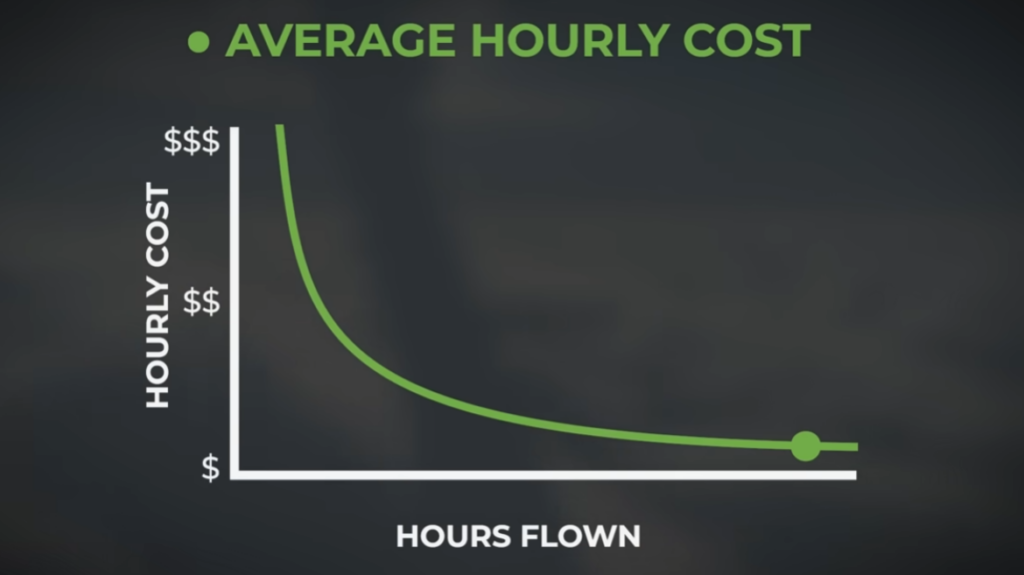
Fixed costs occur regardless of if you fly or not… it’s the hangar, insurance, annual inspection, etc. Variable costs are incurred any time you fly… it’s mainly fuel but there are some others as well.

The more you fly, your fixed costs don’t change, but they are spread out across more flight hours. Meanwhile, you incur variable expenses every time you start the engine.
There are a lot of moving pieces here, and so to make things easier I put together a whole airplane buying roadmap that provides steps A-Z. And when you get that, you’ll also get the budgeting spreadsheet at the same time. You can use this to figure out at a high level what it will cost you monthly, annual, and per flight hour to own.

Go through a model like this and figure out your assumptions and then back into what your estimated purchase price will be based on your monthly budget. Knowing the purchase price range for your aircraft will help in the next step, which is determining the right airplane for you.
This might be a little bit of a back and forth exercise here, but just start with placeholders and estimates and it will get you started in the right direction.
Why the Cessna 182 Worked for Me
Based on this research, a Cessna 182 was a great airplane for me. If you need an airplane that isn’t GREAT at anything but it’s GOOD at EVERYTHING, the 182 is a no-brainer. It can do a little bit of everything and is super easy to fly and every mechanic can work on it.
Once you have an idea of the kind of airplane you want, another really important step is to get familiar with the different models of that specific kind of airplane.
For example, if you know you want a 182, and you go to trade a plane, there’s usually a difference in price for the different models. Don’t just pick the one model year that’s in your price range, but understand why that model year might be less expensive.
They change things across model years and sometimes it’s for the better and sometimes the market would say it was for the worse. One way you can do this research is by joining the owner association for that type of airplane.
The Cessna Pilot’s Association has a document that lists every model of every 182 ever made and exactly what changed on each one.
You just don’t want to fall in the trap of saying “oh I want ___ model of ___ airplane because those models are more in my price range.” You want to know why that’s the case.
It sounds obvious, but when you’re emotionally committed to buying an airplane you can be blind to this kind of stuff and your infatuation can get the better of you.
Another reason to join these owner groups is to find a buying agent that can help you in the process. Personally, I would find a buying agent and my first place to look for one would be inside of these owner associations. If you just start posting and networking in those groups it might turn up some of the most valuable resources for you in the whole process.
Determining the Right Airplane – Six Point Mission
The next step is determining the right airplane. There’s no right or wrong airplane, but you do need to know that buying an airplane is all about tradeoffs.
There’s no “best” airplane. It completely depends on your unique circumstance and the mission you need it to accomplish. Each airplane has something that it’s better at or worse at than other airplanes.
The key is to select an airplane that will work for 80%+ of your flights.
The Six Point Mission
First is budget. What is your budget for purchase and ongoing operation? The previous step will help determine that.
Second is useful load. How much do you routinely need to carry between people and stuff? I would venture to say that this is probably the most limiting stat in small airplanes.
Third is number of seats. How many people do you need to carry?
Fourth is speed. How fast do you need to go? Not how fast do you want to go, but how fast are you actually needing to get there? Think about this practically. The difference in 140 knots and 160 knots on a 200 mile journey is only a difference of around 10 minutes. It’s insignificant.
Fifth is range and performance. How far do you need to go, and what kind of performance do you need along the way? Range also needs to be thought about practically.
Sixth is equipment. How do you need the aircraft equipped? IFR? VFR only?

When you answer all of these with realistic and not aspirational assumptions, you can start to narrow down what kind of plane is going to be able to fit those parameters.
What to Look for in Listings
Once you know what kind of airplane you’re going to be looking for, it’s time to start looking at what’s out there for sale.
It’s easy for emotions to take over here.
Here are the things I look for in listings:
- The price
- The year and model
- Registration
- Pictures
- Quality of the pictures and omissions
- Location
- Total time on the airplane
- Engine time
- Propeller time
- Equipped for IFR or VFR
- Equipment
- Modifications
- Damage history
- Complete or lost logbooks

The logbooks are the aircraft’s diary and provable history of what’s happened to the airplane. Usually when I’m looking through listings, I’m looking for any red flags. I try to look at the listing with a detective hat on and figure out what might be wrong with it.
Building a Comp Model
There’s ONE thing that will either make this a gigantic waste of time or something that is completely invaluable to you, and that’s whether or not you document this research.
You’re going to be looking through a lot of listings, so you might as well take the extra 60 seconds per listing and write this stuff down.
This will turn into a comp model. The way that I do this is I build an excel model with these parameters:
- A link to the listing
- Tail number
- Year
- Model
- Asking price
- Total time
- Engine time
- Propeller time
- Exterior / Paint
- Interior
- Avionics
- Upgrades / mods
- Complete logbooks
- Damage history

Do this simple step, and I promise it will make a massive difference in your research.
Getting Ducks in a Row
While you’re looking at listings, there are a few things worth doing in the background so that once you find a listing you like, you can be in position to actually pursue it.
Here are some of those things:
- Get your pre-approval for financing
- Contact your aviation insurance agent to make sure you can get covered in the type of plane you want, and what training (if any) will be required to solo
- Know who will do your pre-buy inspection
- Understand how to wire funds with your bank
- Figure out where the airplane is going to go

Having these things in place will allow you to pursue the listing expediently.
Pre-Buy Inspection
Once you find a listing that you want to pursue, you’ll typically get on the phone with the selling agent and try to get them to hold the airplane for you while you can come out and look at it.
The pre-buy is usually similar to an annual inspection where they inspect the whole aircraft. Based on what is uncovered, the parties might renegotiate terms of the deal, accept the aircraft as-is, or end the deal entirely.
Make sure to have your mechanic do the inspection, not the seller’s mechanic.
My advice during the pre-buy is try to be as objective as you can and not be emotionally committed to getting the deal done.
The Actual Purchase
Once all of the pre-buy diligence has been completed and the parties agree to the sale, the actual purchasing process is quite simple.
Funds and Title
Money is wired to an escrow agent, who then wires the money to the seller and delivers the aircraft’s title to the buyer.
Paperwork
An asset purchase agreement is signed, and a bill of sale is created.
Registration
The bill of sale and change of registration form is sent to the FAA along with a nominal processing fee.
There’s really not a lot to it from a paperwork perspective, at least on small aircraft.
Final Thoughts
If you want all of this in a cliff-notes format, grab my free airplane buying roadmap.
The reality of airplane ownership actually surprised me in several ways, and in the video below I’ll tell you exactly what those are so that you won’t be caught off-guard.