

Key Lessons I’ve Learned as a Pilot
I can boil down most of what I’ve learned as a pilot to a few key points. And I promise if you can take these to heart, it’s going to make you a safer and more confident pilot. So, there’s a few key areas here that I want to cover.
I also cover all of the material in this article in the video below. 👇
Safety
Avoid the Big Stuff
The big thing on safety here is trying to avoid the big stuff. Like I have done several videos on this. I’ve done a deep dive on the safety of general aviation because I think it’s a lot more safe than people think and certainly than what YouTube gives it credit for because there’s accident reports like all over YouTube.
Some of that can be helpful. Some of it, I think, can be taken too far to where a lot of people are scared to fly.
But if you study the accident statistics, it’s really the big stuff that can hurt you. It’s loss of controlled flight under a thousand AGL. It’s controlled flight into terrain. It’s inadvertent flight into IFR. It’s these big things. And if you look at all the common denominators, there’s really one common denominator:
The big things come down to pilot error and decision-making.
But the question becomes, what do we do with that? Like yes, we can focus on being safe and making good decisions, but what does that look like practically? And I can tell you because I have made a few mistakes in the cockpit. And I can tell you how this happens.
Safety Slips in Small Stages
No one starts out a flight saying, “I’ll just bust into IFR. I’ll just, you know, control flight into terrain.” Like obviously you’re not going to start out that way. But I will tell you the way that it does happen is this: safety slips in small stages.
I’ve had a couple moments in the cockpit where I scared myself. And I can tell you the common denominator is that I made one decision and then kept pushing it and then kept pushing it. And none of those decisions were scary.
I’ll give you a perfect example. I was flying into an airstrip in Idaho and I saw the runway was a lot lower than I thought. And so I was a lot higher than I thought.
I thought, well, I can still make it so I’ll keep going. So I was kind of high and fast. Then there was other traffic coming and I thought, well, the best way I can stay out of the way is just go ahead and turn in and be in front of them and just get out of the way.
So then I was trying to make a short approach high fast in the mountains. I didn’t really brief the go-around if I’m just being totally honest. I was following a friend in there and I didn’t do my part as a pilot. I’ll just raise my hand on that.
And so I felt committed to the approach because I didn’t know what going around through the valley would look like.
There was a moment there where I was really afraid I was not going to get the airplane on the ground or stopped before the end of the runway, which is a bunch of trees. And I made it, pulled off, and shut down the airplane.
And I was just like, what did I just do?
As I’ve had time to reflect on that, I realized there wasn’t any one really bad decision. It was just all of them kind of lined up. I heard someone in the comments explain it this way.
It’s kind of the Swiss cheese model where Swiss cheese has a bunch of little holes in it.
It’s not that big of a deal, but if all of those holes line up, you can see right through it. That’s when the problem happens. It’s when all the holes line up.
So that is one way you can get hurt. What you need to be on the lookout for is progressively making worse decisions.
Never Assume — Use the Checklist
The other thing that can get you hurt and things that have scared me in the plane is when you assume things are the way that you left them.
If you get back in your own plane that you own but it was in the shop and you think that all the circuit breakers are in or the fuel selector is where you left it, it might not be.
So never ever ever, and I’m telling myself this too, never assume something is the way that it is. When you go through the checklist, take half a second to actually do what it says on the checklist.
I know that sounds obvious while we’re sitting here Monday morning quarterbacking the thing, but in real life that can get you.
So those few points will by and large keep you safe in the airplane.
Training
Nobody Has It All Together
Next, when it comes to training, I have taken five different check rides over the course of my hours. And I can tell you this: no one has it all together.
Every time that I’ve walked into a flight school, I’m always insecure about like, oh, what do I not know? Or that guy sure looks like he has it all together. Like, look how he’s walking. Look at how prepared he is or whatever.
And I can tell you that most people are probably looking at you thinking the same thing. They’re thinking about the stain on their shirt they hope you don’t see.
Nobody has it together. Some people are much farther ahead than you, right? Like they’re at hour 10,000 and you’re at hour 10.
And so that is going to create a difference of like there’s a knowledge gap there. There’s an experience gap there. But anyone who has any ounce of humility will tell you we’re all still learning when it comes to aviation.
We’re all still brushing up on regulations that are just hard to keep at the top of your mind. And everyone is a student at the end of the day.
Most of the Problem Is the Quantity
Next, when it comes to training, I want to encourage you that none of the things you have to learn and keep memorized as a pilot are really all that hard.
Like some things are harder than others, but most of the problem is just the quantity. It’s not the quality of information that’s difficult necessarily. It’s the quantity of information.
And the sooner you realize that, the better off you will be because a lot of this just takes repetition and it takes time and it takes exposure over the course of time.
Like I think about it this way. If you’ve ever set up your thumbprint on a new iPhone, like if you were an Android person, I’m not even sure I’d know how to hold a regular conversation with you, so you probably can’t relate to this, but on an iPhone when you set up your thumbprint, you have to do it a few times.
And I love what the graphic does. It’s like, okay, on that first thumbprint, the top kind of gets filled in. The next one, the side gets filled in. Do it a couple more times, different angles, and then all of a sudden it knows your thumbprint, right? (Which is debatable if that’s even a good idea.)
But the point is, the more touch points you give it, the more that you fill in that complete picture of what’s going on. And aviation is really, really similar.
Over the course of time, I’ve realized like, okay, maybe what I memorized on this first pass, I missed some of this other stuff. But next time with some real world experience, oh, that’s when that concept clicks. So that’s why I’m saying everybody’s a student. You’re just going to need reps and exposure.
Why I Created These Flashcards
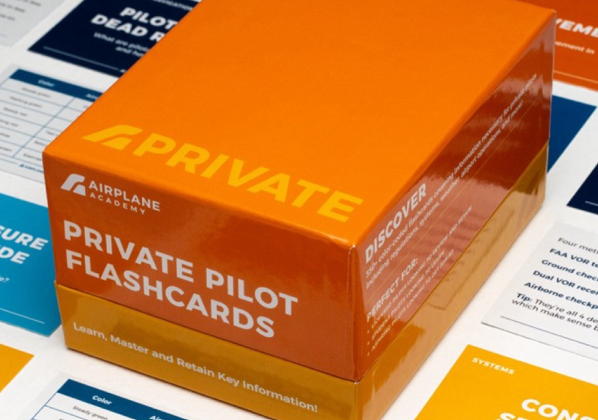
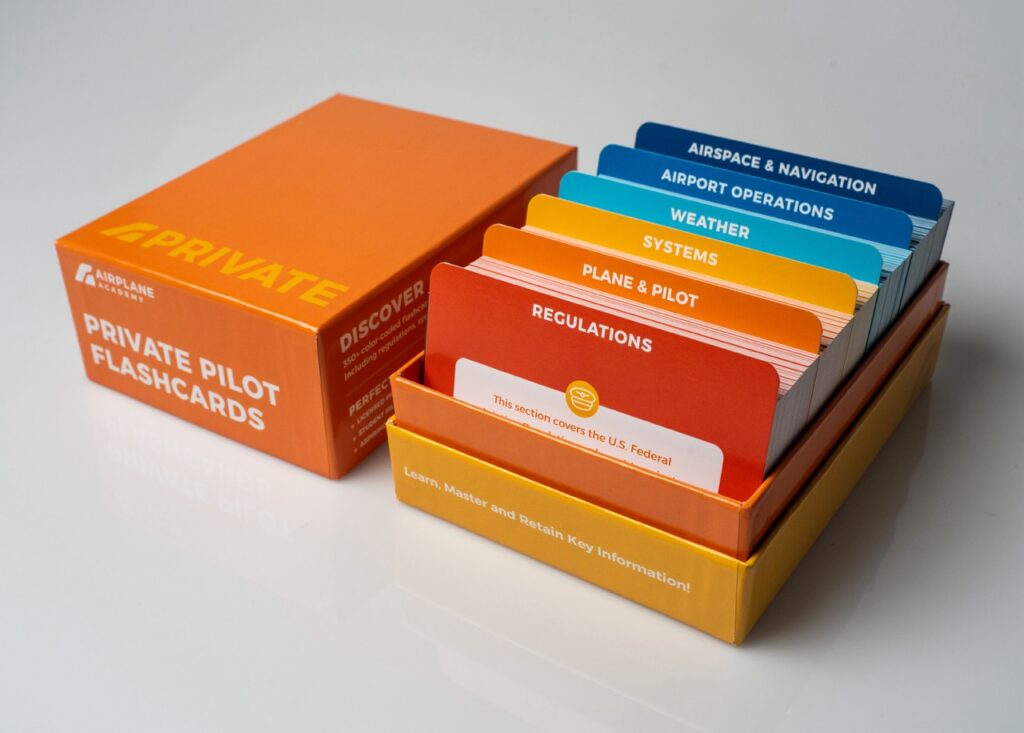
Because I have been so overwhelmed with the quantity of information that you have to know as a pilot, I spent almost a year and a half creating this set of robust private pilot flashcards. There’s over 350 in the set. And it was a beast to make.
But I got tired of being so nervous for check rides and walking into flight reviews being like, I don’t know, what do I study for this? Like it seems like all the information is here and there and there. But I literally need it in a box. I need it right in front of me so that I feel like I can attack it and it’s all in one place.
So I went through a lot of work to try to create that myself. I had a talented pool of instructors that helped with oversight and reviewing and approving all of this stuff. So I hope you’ll check it out. I hope that it can help you.
It’s over at airplaneacademy.com/flashcards. And I think it can make the quantity of information that you need to know a little bit more approachable.
The Middle Is Going to Be the Hardest Part
Next in training, and man, I wish someone would have told me this sooner: the middle is going to be the hardest part.
There’s this really cool chart that’s like the emotional cycle of change anytime you pursue something difficult or that takes a little while.
And when you start out, you have all of this uninformed optimism. Like you’re pumped. You have no clue how hard it’s going to be, but you’re just dreaming of the end outcome. You have no appreciation for what you’re about to endure.
And then as you get into things, all of a sudden that uninformed optimism flips. It turns into informed pessimism. You’re like, “Oh shoot, what did I get myself into? This is hard.” And that feeling is probably going to get worse and worse as we go down the curve here until the middle, which is referred to as the valley of despair.
Sounds overly dramatic, but I promise if you’ve been there, it’s accurate.
You’re tired and you also have an appreciation for the amount of work left and you’re like, I don’t know. This is going to be really difficult. It’s going to take a while.
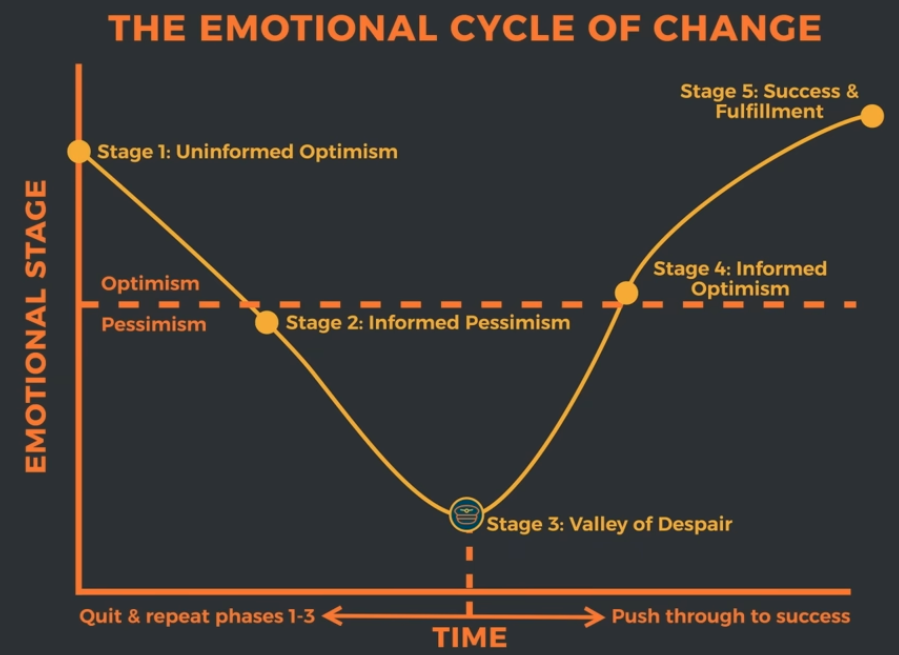
But if you can push through that, it will get better. You will climb the curve to where you all of a sudden have informed optimism. You’re like, you can see the light at the end of the tunnel and you’re confident that you can finish. And then if you keep going, you’ll finish your goal.
Flight training totally follows this pattern. If you’re not expecting it, you’re not ready for that middle. You will probably quit in the middle. Love you, but that’s probably where you’ll quit.
And I know because that’s where I quit in my commercial rating. I quit more than once because life got in the way. I got into the valley of despair. I was like, oh man, there’s a lot of stuff to remember. There’s a lot of new maneuvers. Then the weather’s bad and then the plane’s in the shop and like you get behind. Life gets in the way, right? I quit multiple times.
Do a Dedicated Sprint
So the other big piece of advice here I have from my own experience is as much as you can, try to do a dedicated sprint. If you’re going to get your private or anything else, don’t just take it casually. I mean, do the best you can, but as much as you can really try to say, look, my life is not going to make this the most important thing, right?
Like you got family and kids and whatever. That’s more important. But everything else, all these other things that I could pursue right now, I’m going to pause all of that because I’m all in on training.
So in evenings, most evenings a week, I’m studying. I’m not catching up on Netflix. I might not be watching the game or something unless that’s just part of your recovery and helps you stay in the game longer because you can actually relax and recover. But the point is, do a dedicated sprint.
When I finally did that for my commercial rating, that’s when I actually passed. That’s when I got things done. Most nights after the kids went to bed, I was studying. Several mornings a week really early before work, I was going and getting my flight training knocked out and stuff and it just kind of revolved around it until I got it done.
Then I did the same thing with my multi-commercial and I’m like now, this is how I’ll do it from now on on anything big. Dedicated sprint for the win.
Put the Next Step on the Calendar
Something else that can help with this is just to get every baby step on the calendar. Never leave a lesson without having your next lesson on the calendar. Never leave a study session without having the next study session on your calendar.
If you’re in the very beginning stages of your training right now, maybe the next step is putting a thing on your calendar tomorrow to call the flight school and book the discovery flight. Just put something on the calendar to keep the momentum moving.
And I really just want to encourage you that you can do it. That’s probably the most important part. The message of my channel is just you can do it.
Matt’s Story
I want to read you a comment that I got a little while back from a guy named Matt. I got to connect with him after he left this comment. I was just blown away by his story and I think it’ll encourage you.
He said, “Last year I stumbled upon one of your videos. You were encouraging those who wanted to become a pilot to just do something towards making that happen, take a discovery flight, etc. I had found reasons to put it off for years. But after watching that, I took a flight and that was more than a year ago. And on Monday, I passed my private pilot check ride.
“My journey required juggling a full-time job, a second full-time job I needed to pay for flying, two kids, and then a surprise newborn joining the party. Despite many challenges, a childhood dream is in the logbook. And for those who doubt it’s possible, I did it with family and a single income. It was hard, but it’s possible.”
So, way to go, Matt. And all the people that it will encourage, I’m thankful for you.
Flying the Airplane
Get Good at Energy Management
In terms of actually flying the plane, I would say that most of my flying advice really comes down to two words. It’s getting good at energy management. And I think the best way to get good at energy management is to be comfortable flying slow and landing short.
So I really, really suggest that at some point when the time is right, go train with a flight school that specializes in landing on grass and landing short. You could go to guys like TacAero, who I’ve gotten to film with a few times.
Awesome, 10 or 11 out of 10 in terms of their flight training and just them as people. Awesome, awesome guys and gals down there in Fredericksburg, Texas.
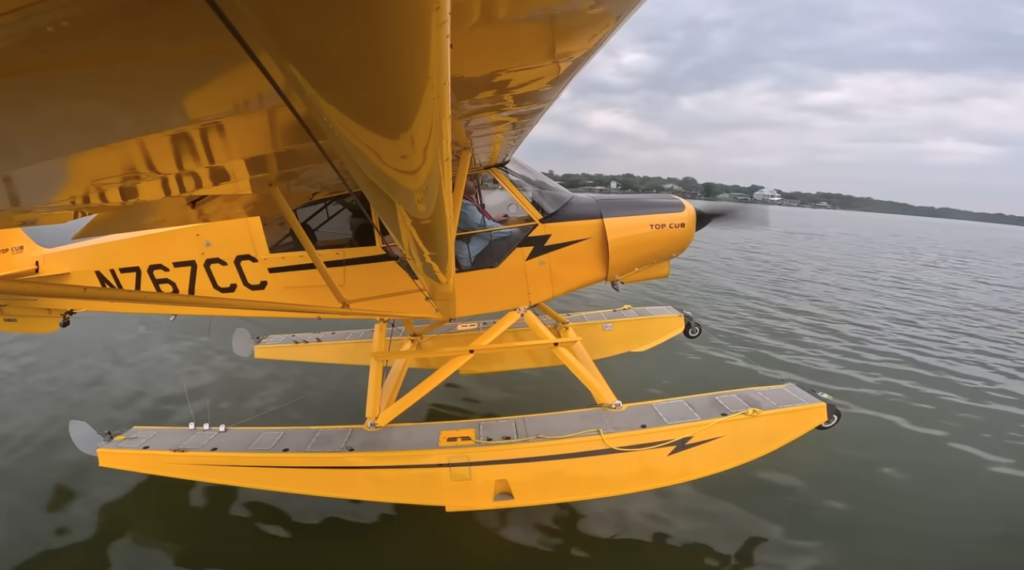
I got to fly in a Top Cub with them and film it. We landed on progressively shorter airstrips and then ultimately landed on this sandbar next to a river. And I was just hooping and hollering. I was so excited. And it was so cool.
But it really stretched me to get more comfortable flying slow and landing short. And that’s when you’re going to get really good at energy management, trying to make the airplane do exactly what you want it to.
The Seaplane Lesson
If you can fly with guys like that, or fly Oz out in Arkansas because they specialize in that stuff too, or go get your seaplane rating, I’d say one of the coolest things I ever did was get my seaplane rating in Alaska. That was mind-blowing up there.
But in Texas, the coolest moment I had, and it was with TacAero again, was landing this seaplane near Marble Falls. We actually got to taxi under a bridge. So I was like, I’ve never been under something in an airplane before, which is kind of crazy.
We got to do this really, really cool approach kind of coming around this mound where you had to land before a dam. And so it’s kind of a short field landing in a seaplane. You’re kind of having to come down and hug this ridge and stuff.
So you’re really having to manage your energy. And I ended up coming a little too fast. Everything went okay. But it was a really good lesson in just really making the airplane do what you want.
And then you can get into some really beautiful, scenic, interesting places if you can be really good at energy management. So try to get with people like that that can teach you that stuff. You’d just be amazed what an airplane can do.
Practice Slow Flight
But even short of that, if you’re just flying around in your 172 or whatever, just practice slow flight. If you can get really, really good at slow flight, it’s going to make your landings better. It’s going to make everything better.
So that’s something we usually learn early on in training and then it’s not necessarily that fun of a maneuver, but it’s so, so helpful to be comfortable flying slow.
Free Resource
Before my last point here, I want to let you know of a free resource you might not be aware of. Recently, I put together a really long PDF that shares 88 takeaways from my 18 years in flying.
It’s the stuff I’ve screwed up, the things that thankfully I’ve done right, and it’s really, really skimmable. It’s color-coded by section of here’s the story and here’s my takeaways. So you can just skim all 88 takeaways.
Hopefully it can help you in your flying journey. It’s totally free. It’s over at airplaneacademy.com/takeaways.
Talking to Air Traffic Control
I’d say one area that most pilots, myself included, struggle with when we’re learning to fly is talking to air traffic control. It can be really intimidating.
I learned in the Dallas Class Bravo airspace, and so it’s intimidating when it’s you and a Southwest jet and all these people and you’re like, “Oh, help me.”
But I promise it gets so much easier.
And it can really boil down to one thing, and that’s knowing what to expect. Once you know what to expect and you realize it’s like 95% the same thing over and over and over, your confidence and proficiency will just skyrocket.
And to help you do that, in the video below I walk you through an average flight coming in and out of a towered airport talking to approach control and stuff. I try to make it really easy for you so that you’ll know what to expect so you can be confident too.
You can check it out here: