

As of this writing, I’ve passed five checkrides, and every piece of advice you’re about to read comes from one of two places:
- Things I did wrong and regretted
- Things I did right and am very glad I did that way
So if you’re willing to listen and actually implement this, I genuinely believe it will help you.
If you’re reading this, there’s a good chance you’re feeling at least a little nervous about an upcoming checkride. That’s normal. And the first thing I want to address is something I think gets misunderstood all the time.
You’re Not Supposed to Feel 0% Nervous
I hear people say, “If you’re prepared, you won’t be nervous.”
I don’t agree with that at all.
When I proposed to my now-wife, I was 100% confident it was the right decision. I had everything planned, I had her family’s blessing, and I knew she was going to say yes.
And I was still shaking in my boots.
That’s when it clicked for me: when you deeply care about the outcome of something, nerves are part of the deal.
So yes — prepare. Study hard. Take it seriously.
But don’t be alarmed if the nerves don’t disappear entirely. That usually just means you care.
I’ve been nervous for every single checkride I’ve ever taken (even though I was prepared).
Peel Back the Onion on Your Fear
When you feel nervous, spend two minutes asking why.
For me, it usually goes like this:
- I’m nervous because I don’t want to fail.
- Why don’t I want to fail? Because I’ll feel like a failure and have to tell people.
- What happens if I fail? I retrain with a CFI and retake that portion.
- Then what? I pass.
So best case: I pass the first time.
Worst case: it takes more than one try… and I still pass.
Either way, I end up with the certificate.
When you walk that fear all the way to the end, you realize it’s often an ego thing. And once you name it, it loses a lot of its power. Or you can at least work the root problem.
The people who matter in your life won’t love you less or be less proud of you if it takes more than one attempt. Remembering that alone can take a huge edge off the nerves.
How to Actually Study for the Oral: “Cleaning the China”
Most people study by cramming information into their brains:
- Re-reading notes
- Highlighting books
- Skimming oral exam guides
The problem is, research consistently shows these are some of the least effective ways to retain information.
I recently watched a video by Ali Abdaal breaking down learning studies, and one method stood far above the rest:
Active recall.
Instead of pushing information in, you pull it out.
I like to think of it as pull → polish → push.
Your brain is like a cabinet full of valuable china. The information is already in there — it’s just dusty. You need to pull it out, polish it, and put it back.
What This Looks Like in Practice
- If you’re reading an oral exam guide, answer the question before reading the answer.
- If you have notes, rewrite them as questions, not statements.
- If you use flashcards, force yourself to answer before flipping the card. Otherwise, you’re just reading a textbook.
This one shift can make a massive difference in how prepared you actually feel.
It forces active recall. And when it comes to memorizing things (really, becoming fluent), active recall is your best friend.
A Turn-Key Option (If You Want One)
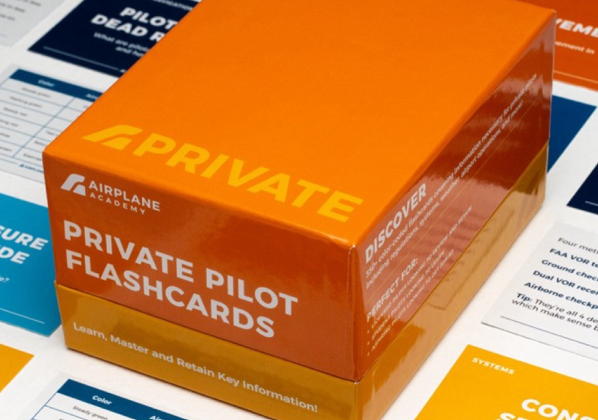
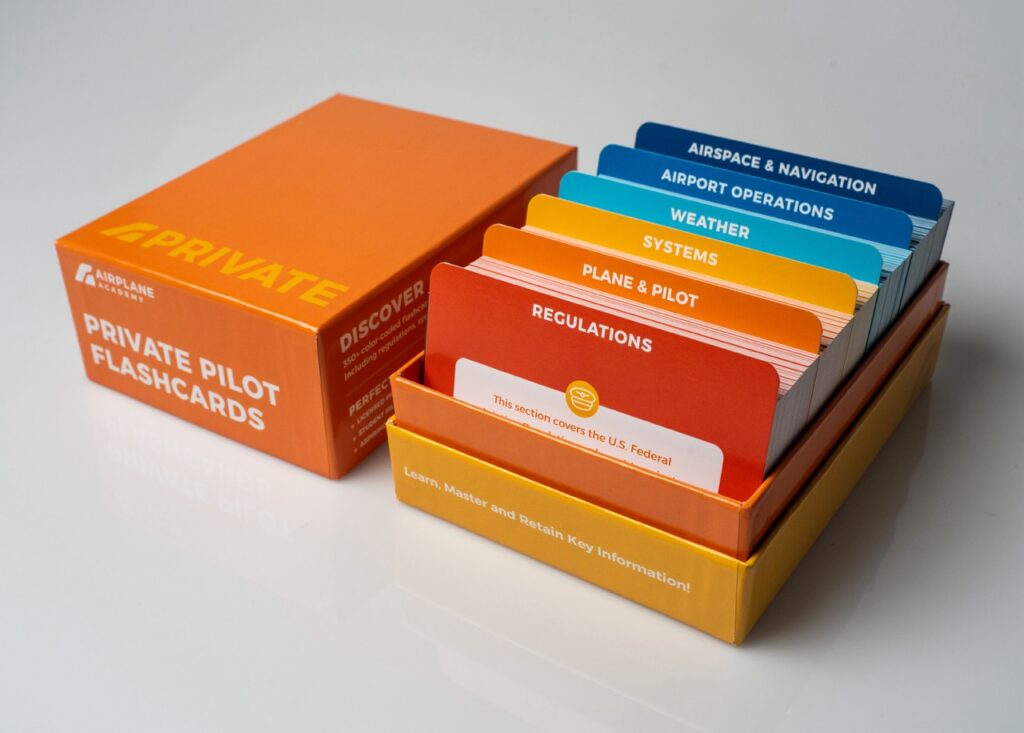
If you want a ready-made way to practice active recall, I recently launched my own study flashcards.
There are over 350 cards, they took me nearly a year and a half to make, they’re reviewed by flight instructors, and they have been used by thousands of pilots.
You can check them out at airplaneacademy.com/flashcards if you want to learn more.
During the Oral: Answer the Question… Then Stop Talking
This is critical.
Think of the oral like the opposite of a first date.
You are not trying to impress anyone with long, charming answers.
Answer the question.
Then stop talking.
If you keep elaborating, two things happen:
- You increase the odds of saying something wrong
- You give the examiner more rabbits to chase
Silence is okay. Let it exist.
If you want practice with this, watch mock checkrides on YouTube. They are one of the greatest gifts aviation has on the internet. Take notes — and turn those notes into questions for active recall.
Also, ask your CFI for a mock checkride. Most are happy to do it, but don’t assume — ask.
Organization Matters More Than You Think
On my commercial checkride, I numbered every page of both logbooks and built a spreadsheet mapping each flight requirement to the exact page number where it was met.
It eliminated all the “fishing around,” and the DPE genuinely appreciated it.
I also recommend:
- Having all documentation organized ahead of time
- Bringing aircraft logbooks and being ready to show inspections and AD compliance
- Arriving early and laying everything out neatly
It sets the tone before the checkride even starts.
Don’t Get Comfortable Too Early
One of my biggest regrets came after an oral that I felt went really well.
I relaxed. Then I got a little chummy.
During preflight, the DPE casually asked, “What are your options if we lose the engine on departure?”
I instinctively joked, “They’re not good.” (Because at Addison, that’s true.)
She replied, “That’s not an answer. What are our options?”
That snapped me back into reality fast.
A lot of times we think about how to stay composed if things aren’t going well. But the opposite is also true:
No matter how well it’s going, stay professional and focused the entire time.
In the Air: Slow Down and Set Up Properly
When transitioning from cruise to maneuvers, don’t rush.
Slow down. Configure properly. Start at the correct airspeed.
And remember: sometimes the maneuver setup might even be the setup for an emergency.
On my multi-engine commercial checkride, right as I finished a clearing turn for steep turns, the DPE pulled the fuel on one engine. Real engine failure. No warning.
Stay alert.
Narrate Your Corrections
Perfection is not the standard.
If something is off — altitude, airspeed, coordination — say it out loud and correct it.
DPEs examine for a living. They see it.
What matters is whether you see it.
If they know you’re aware and correcting, you’ll usually be given more latitude than if you silently hope they didn’t notice.
Final Thought
You can pass this checkride.
And even if it doesn’t go perfectly the first time, you can still end up with the certificate in your hand and move on with your life.
Prepare well. Study smart. Stay composed.
And if you want help with active recall and oral prep, check out my private pilot flashcards. They are a 350+ card physical flashcard system used by thousands of pilots since April 2025 to prepare for checkrides, flight reviews, and ongoing proficiency.